
Where Landscaping and Snow Removal Crews Store Equipment in Denver

Landscaping is really two businesses sharing a garage. Mowers, trimmers and trailers from spring through fall. Plows, spreaders and salt from November on.
The problem is that neither set of equipment goes away when the other one is working. You are storing all of it, all year, and half of it is idle at any given moment.
The seasonal squeeze
Most crews start with a trailer at the house and a shed for the hand tools. That works for one truck and one mower.
It stops working the first winter you add a plow truck. Now you have a truck with a blade on it that nobody wants parked on their street, a spreader that has to stay dry enough to work, and a mowing trailer that is not going anywhere for four months.
Denver metro residential zoning generally does not allow commercial vehicles parked on a lot, and an HOA will be quicker about it than the city will.
What actually needs to be inside and what does not
This is where landscapers overbuy. Not everything needs a roof.
Mowers, plows, trailers, skid steers and dump trailers are built to sit outside. They live outside while they are working. Parking them on gravel behind a gate does not hurt them.
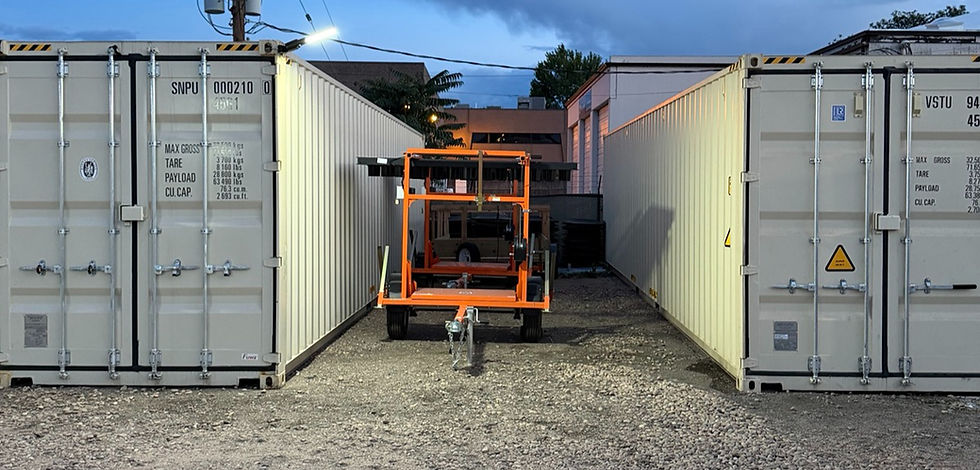
What you want locked and dry is smaller. Trimmers, blowers, chainsaws, blades, spreader parts, fuel cans, fittings and the hand tools that disappear first. A 20 foot container holds all of that with room left over, and it costs less than a climate controlled unit that cannot take the trailer anyway.
That combination, a container for the small gear and open ground for the vehicles, is what most crews end up with. It is described in more detail on the contractor storage page.
Sizing it for a landscape and snow operation
At the Wheat Ridge yard on Van Gordon, a standard 800 square foot space runs $530 a month. That is about 20 by 40, enough for a truck and a mowing trailer.
1,200 square feet at $730 fits a plow truck, a trailer, and a mower or two beside them.
1,600 square feet at $930 is the size a crew running two trucks plus a skid steer tends to need, because you have to leave yourself room to load and unload without shuffling everything first.
Add a 20 foot container for $180 and the hand tools stop living in the truck bed.
Why access hours matter more in winter
A snow event does not start at nine in the morning. It starts at two, and the difference between a gate you can open with a code and a facility that opens at eight is the difference between servicing your accounts and losing them.
All three Colorado yards run 24 hours a day, seven days a week, through a coded gate. There is no office to call and no hours to work around.
The honest limitations
These are outdoor yards on gravel. There is no power at the space, so you are not running a battery charger or a heater out there.
The yards are unsupervised. Put your own lock on your own container and carry coverage on anything expensive, because the lease does not cover theft.
You also cannot do fluid changes on site. Minor maintenance is fine. Oil and hydraulic fluid are not, because gravel has no containment.
Where to look
Box Yard runs three yards across the Denver metro, one in Arvada and two in Wheat Ridge. The landscaping page covers what the setup looks like for green industry crews specifically.
Spaces turn over month to month, so what is open changes week to week. Check current availability before the first storm, not after it.


Comments